
 |
Open Audit
25 May 2016 9h30 – 13h00 CJL – Centro de Juventude de Lisboa (Youth Center of Lisbon) |
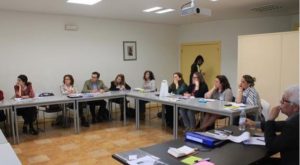
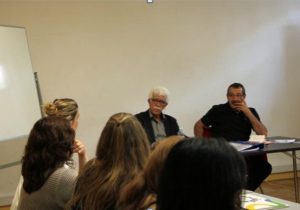
The session was attended by 16 people from several institutions of the Lisbon Region:
IPDJ – Portuguese Institute of Youth and Sports
ISQ – Welding and Quality Institute
Association KRER+
Casa SEIS
Association Raízes
Community Center São Sebastião – Setúbal
Gustavo Eiffel Vocational School
Municipality of Odivelas
APPY
Parish Council of Olivais
Horas de Sonho
Catholic Workers Youth
Gebalis
Workshop facilitators:
Bassou Bebyoucef – Asmoune
Carlos Ribeiro – Caixa de Mitos
Program
Part 1: Introduction by Carlos Ribeiro. The objectives of Comwork and the Caixa de Mitos perspective on the training processes and the skills of professionals that work with young people in NEET situation.
Part 2: Cases and experiences related with training methodologies that aim at the DPA – Acting Power Development.
PART 1 – The framework of debate and hearing was carried out by Carlos Ribeiro and focused the following themes:
- Why is it justified a specific training approach for young people in NEET situation?
- Nevertheless, what is common to other training processes?
What justifies a specific training approach for young people in NEET situation?
It’s important to start the debate by opposing the semantic “ghettoization” process, that results of using the words “NEET young people”.
This way of mentioning the participants of training activities that are young people facing the situation of not being in employment or in school or in vocational training, translates a progressive social categorization similar to the one made with unemployed people. In fact, the word ‘unemployed’ became a social “status”, rather than meaning a situation regarding employment.
What is happening with young people who accumulate several negative situations in the areas of employment and qualification is the same.
There are no “NEET young people.” There are negative situations in the social sphere in which real people can be inserted. But there is no such thing as “NEET”; people are cumulatively in various situations of need that can be, in addition to employment and education, of housing (to be without home), health (to lose capabilities and mobility), social environment (to live with no aid or support systems), etc.
Thereby, the first question that arises in terms of defining the powers of intervention of professionals, is that social workers should start by giving any young people participating in training activities, the possibility to make the “deconstruction” of negative representations associated to them, in stereotypes like “addicts”, “gypsies”, “outcasts”, etc.
The second aspect to consider is how to deepen the specific context of each young person who accumulates social and personal negative situations, in its relation to training activities. This means looking critically into proposals derived from a framework originated outside their environment (the logic of OFFER). The utility of training courses has to be evaluated due to the extreme state of vulnerability and especially of disbelief towards the future that each young person in NEET situation carries with him/ her.
Everything indicates that the traditional approach will have to be reversed and strategies originated in the perspective of young participants (the logic of DEMAND) will have to be adopted; the logic of action centered on “motivation” to participate in training, should be reversed to an approach originated in the “demand”, which means considering as priorities those established by young people themselves and co-building with them a common activity of solutions that may be of interest and impact on their skills and their development.
Another specific dimension when addressing young people in NEET situation that is absolutely crucial is targeting the groups you’re working with, adopting at least the four major categorizations given by the Eurofound report: structural unemployment; unavailable; not-affiliated; active in seeking opportunities.
The initial approach will be different depending on the target and even the importance of training activities should certainly be measured by the creative combination of a specific generic classification and the characteristics of the subjects.
What may be common to other formation processes?
If activities with a strong training component are necessary, its organization should be guided by the principles and proper methods of non-formal education, and not structured by the dominant model, the school model.
On the other hand, it’s necessary to begin the training processes in a way that makes sense and that has been developed together with the young participants, involving the everyday life in the learning cycle dynamics.
Training activities should also focus in action, by adopting an active and participative methodology based on the co-production.
Together with training processes whose programs are co-built with the participants, it should be privileged training processes between and by peers. This will ensure that the basis of learning lies in the contexts that are familiar to each participant.
Finally the professional function that accompanies and streamlines these training based activities, should play the following roles:
– Facilitators, not leaders;
– Mediators between resources and young people and not organizators of training;
– Guidelines inspired in Paulo Freire theories, assuring that the all process have strong relationships with active citizenship and encouraging transformative education initiatives that support social change.
Part 2: Cases and experiences associated with training methodologies aimed at the DPA – Acting Power Development
Participants at the meeting presented their training experience with a focus in adaptation to unique contexts and the specific persons accompanied.
– Music: the case of “orchestras generation”;
– Sports: the Benfica Foundation and the Program “for you if you don’t miss school”;
– Theater: theater Ibisco, Interbairros theater for inclusion;
– Sailing: Nautic Club Boa Esperança and experiences in Alfama Sea Program;
– Judo: Nuno Delgado school and social inclusion programs
From the reported experiences and discussions emerged points of convergence and almost unanimously that were organized by Carlos Ribeiro, as follows:
– The urgent need that the basis of all training activities and monitoring has to be the local partnerships. Without the complementary functions, people, styles, training cultures of various organizations, the objectives of involvement and commitment of the participants in an effective development process can’t be achieved. It’s a mistake to think of these activities as a “course”, knowing that the past relationship of potential young participants with the school is at least tense and may even be associated with the outcomes of failure and exclusion.
– The mobilization of the resources of the territory as the background of the personal development plan, with areas to be explored as a priority (in opposition with the formative logic in the classroom or training room). Sports, culture, theater, video, film, crafts, these and other areas of local life are the priority fields;
– The mediating function of professionals based on a position and actions that have to be neutral and impartial
– Doing with implies a relationship with the person but also with his/her context (surroundings) including family and belonging groups.
Carlos Ribeiro | Caixa de Mitosd
Part 2: Cases and experiences associated with training methodologies aimed at the DPA – Acting Power Development.
The study of TAPAJ case – Alternative Daily Work Paid www.tapaj.org
The themes of the meeting were addressed with a concrete exemple of direct application brought by the program TAPAJ, which is structured as a bridge for the monitoring of young people living in extreme social vulnerability, particularly in street and in wandering.
It’s an approach that involves:
– Identification: the work of localization is made by “street educators” who perform monitoring and support activities. Concerning this matter, it should be noted that the skills of adaptation to the environment and the approach capabilities (distance mechanisms management) are crucial;
– ‘Contour pedagogy’: an approach by narrow paths, focusing in secondary processes that facilitate reaching a central goal;
– Valorization system: put participants in recovery and self-recognition status to cement the conditions of self-esteem and confidence that must be the starting point of any future participation in training.